
Why Russian Has No Articles (But Polish Almost Does)
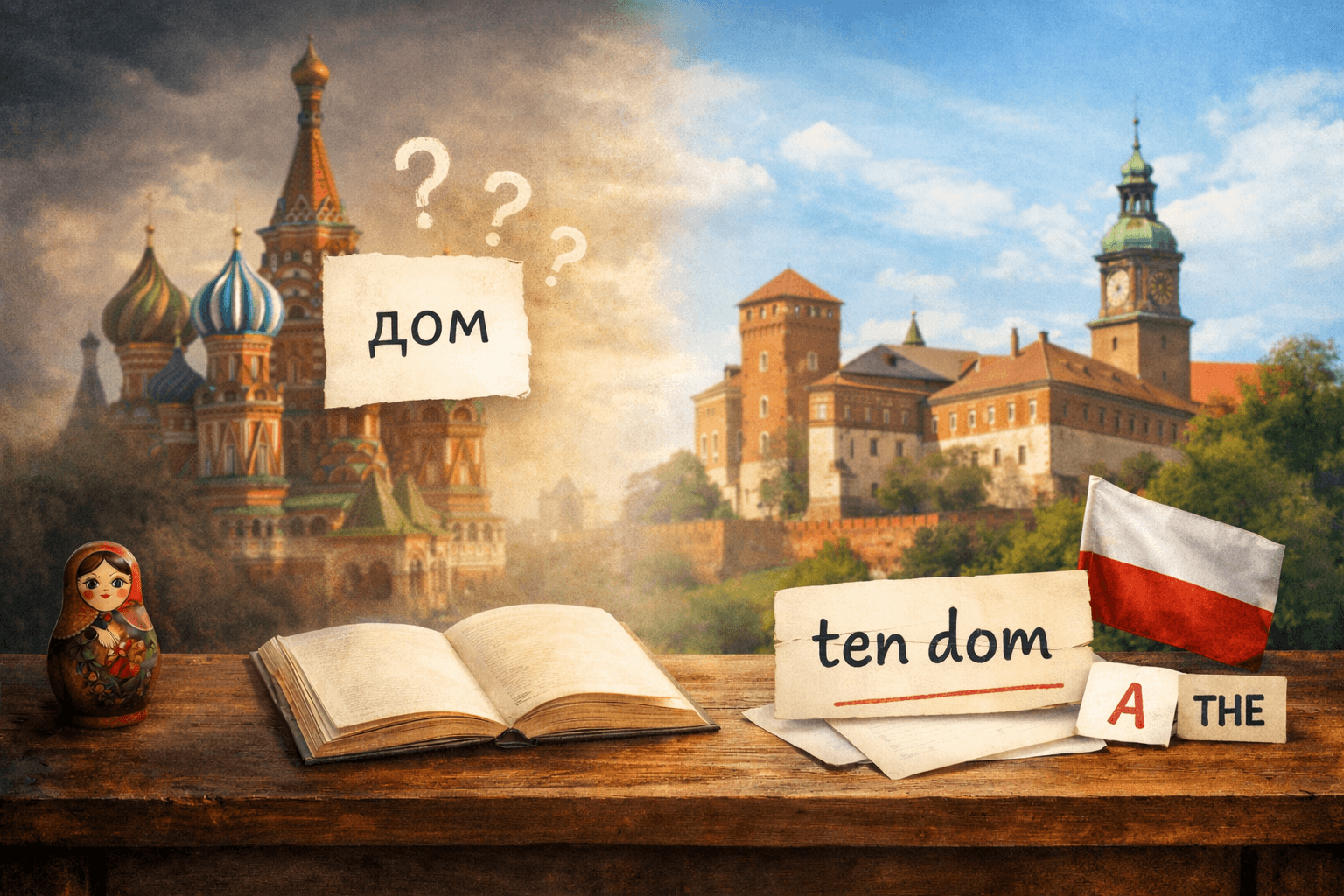
If you've ever studied Russian after learning English, French, or Spanish, you've probably had that moment of relief: Wait, no articles? No 'the' or 'a'? It feels like linguistic mercy—until you realize that what Russian skips in articles, it makes up for in six grammatical cases. But why did Russian (and most Slavic languages) never develop articles in the first place? And why does Polish sometimes act like it's this close to having them?
Let's dig into the grammar, history, and weird exceptions that explain this Slavic quirk.
What Even Is an Article?
Before we go further: articles are those little words like English the (definite) and a/an (indefinite) that mark whether a noun is specific or generic.
- "I saw the dog" → You know which dog.
- "I saw a dog" → Some random dog.
Most European languages have them: Romance languages (le, la, un, una), Germanic languages (der, die, das, the), even Greek. But Slavic? Nope. Well... mostly nope.
The Proto-Slavic Explanation: Case System Overload
Proto-Slavic—the ancestor of all Slavic languages spoken around the 5th–9th centuries—had no articles. Why? Because it had something else doing the job: a hyper-detailed case system.
In Russian, nouns change endings based on their role in a sentence:
- книга (kniga) = book (nominative, subject)
- книги (knigi) = of the book (genitive)
- книге (knige) = to the book (dative)
- книгу (knigu) = book (accusative, direct object)
- книгой (knigoy) = with the book (instrumental)
- книге (knige) = about the book (prepositional)
These endings already encode definiteness and context. If someone says Я читаю книгу (Ya chitayu knigu, "I'm reading book"), the accusative case книгу implies it's a specific book. No article needed—the grammar already told you.
Languages that rely heavily on case systems (like Latin, Finnish, or Old English) historically didn't need articles either. When word endings do the heavy lifting, little helper words become redundant.
Bulgarian & Macedonian: The Rebel Slavs
Now here's where it gets weird. Bulgarian and Macedonian—both South Slavic languages—do have articles. Sort of.
Instead of saying the book, Bulgarian tacks the article onto the end of the noun:
- книга (kniga) = a book
- книгата (knigata) = the book (definite article -та fused to the noun)
Why? Bulgarian and Macedonian lost most of their case system over centuries of contact with non-Slavic neighbors (Greek, Turkish, Romanian). Without cases to carry meaning, they borrowed the Balkan habit of using articles. Linguists call this the Balkan sprachbund—a geographic zone where unrelated languages start copying each other's grammar.
So Bulgarian is technically Slavic but grammatically acts half-Balkan. It's the family member who moved abroad and came back with an accent.
Polish: The "Almost" Article
Here's the fun part: Polish doesn't have articles... officially. But in spoken Polish, people constantly use ten/ta/to (that/this) in ways that really look like definite articles:
- Formal: Czytam książkę (I'm reading a book)
- Colloquial: Czytam tę książkę (I'm reading the book)
The word ten (this/that) is technically a demonstrative, but Poles use it so casually that linguists debate whether Polish is developing articles in real time. You'll hear:
- Ten facet = "that guy" (but really just "the guy")
- Ta książka = "this book" (but meaning "the book we were talking about")
It's like Polish is experimenting with articles but hasn't committed yet. Give it another 200 years.
Other Slavic Languages: Hard Pass on Articles
- Czech, Slovak: Nope. Case system intact, no articles.
- Serbo-Croatian: Nope. Though like Polish, demonstratives (taj, ta, to) sometimes fake it.
- Slovene: Nope, but also loses cases faster than other Slavs.
- Ukrainian, Belarusian: Nope. Follow Russian's lead.
The pattern? Strong case system = no articles. The moment cases weaken (like in Bulgarian), articles sneak in to fill the gap.
So Why Did Russian Keep Its Cases?
Geography and isolation. Russian expanded eastward into Siberia and Central Asia—areas with Turkic and Uralic languages that also have no articles. There was no pressure to adopt them.
Meanwhile, Bulgarian sat in the Balkans getting squeezed by Greek and Turkish, both article-heavy languages. Over centuries, Bulgarian grammar bent toward its neighbors.
Does This Make Russian Easier or Harder?
Easier: No memorizing der/die/das or le/la/les nonsense. Harder: You memorize six cases instead. Pick your poison.
For English speakers, the lack of articles feels liberating at first—then you hit genitive plural endings and realize you've traded one nightmare for another.
The Takeaway
Russian has no articles because Proto-Slavic didn't need them—its case system was already doing the job. Most Slavic languages kept this setup. Bulgarian and Macedonian are the exceptions, having traded cases for articles under Balkan influence. And Polish? It's flirting with articles through demonstratives but hasn't made it official yet.
Want to explore how case systems work across Slavic languages, or compare Polish's ten to Russian's case endings? Check out Slavonaut's conjugation tables for side-by-side morphology breakdowns across 20 languages.
Because sometimes the best way to understand why a language does something is to see what its cousins are doing differently.